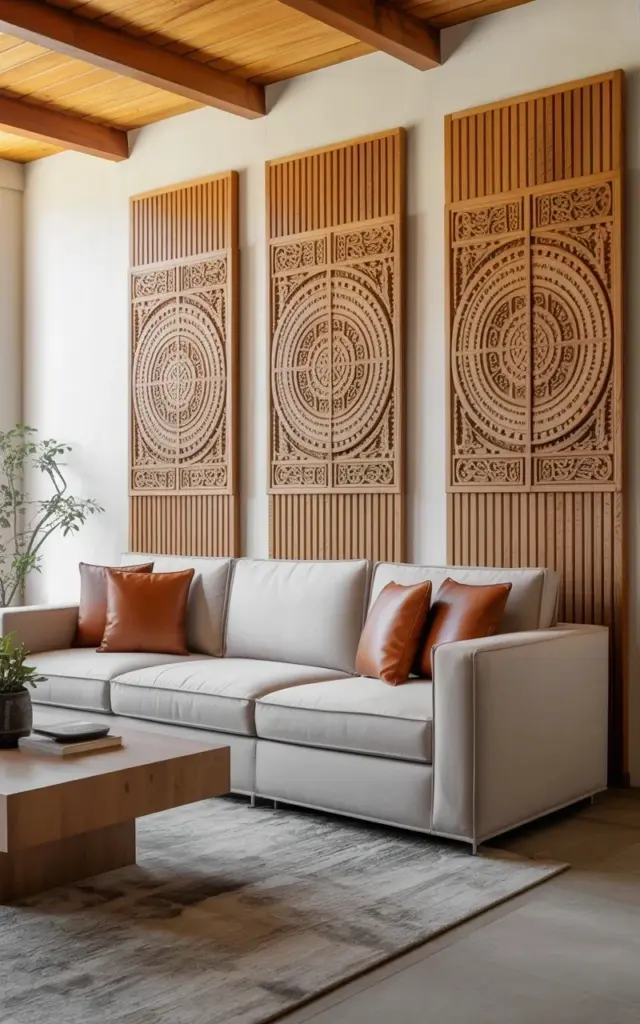
The first thing you notice in this room isn’t the sofa or the coffee table. It’s the wood accent wall panels, three large slabs of natural oak mounted right on that crisp white wall. They completely change the temperature of the space. This modern living room with wood accent wall panels pulls off a tricky balance: it feels expensive and polished, but you also want to kick off your shoes and stay awhile. The carved circles and vertical grooves in the wood break up the flatness of the drywall, while the terracotta pillows on the gray sectional add just enough warmth to make the whole setup feel lived-in rather than staged.
If you have been scrolling through Pinterest for the perfect remodel idea, you probably already noticed that wood paneling is having a serious moment. But I want to talk about how to do it without turning your living room into a log cabin. The secret is in the finish, the scale, and how you style around it. Let’s break down exactly how this look works, what it costs, and how you can pull it off even if you’ve never installed a single plank in your life.
Why Wood Accent Wall Panels Work in a Modern Living Room
Modern design gets a bad rap for feeling cold. Clean lines and open spaces are great, but they can leave a room feeling sterile, like a showroom nobody actually lives in. Wood fixes that instantly. Wood accent wall panels bring in texture, depth, and that organic warmth you can’t get from paint or wallpaper. They add a natural element that softens all the straight edges and hard surfaces typical of contemporary interiors.
In the photo above, the panels don’t cover the entire room. They’re positioned directly behind the sectional sofa, creating a focal point without overwhelming the space. That’s the smart way to do it. You don’t need to cover every wall. A single feature wall, or even just a section of one, is enough to anchor the room. The grey sectional sits against the panels like it was meant to be there, and the wood grain picks up the warm tones in the terracotta pillows. It’s a small trick, but it makes the entire room feel connected. Here’s the thing: you don’t need a massive renovation budget to get this look. You just need the right panels and a little planning.
Carved Circle Panels vs. Simple Slats: Choosing Your Style
Look, not all wood panels are created equal. The panels in this living room have a very specific design detail: carved circles combined with vertical striations. That pattern adds an artisan, handcrafted feel that flat panels simply don’t have. The circles catch the light at different angles throughout the day, and the vertical grooves draw your eye upward, which makes the ceiling feel higher. It’s a subtle you-know-it-when-you-see-it kind of finish.
For your own space, you have options. Here’s a quick breakdown of what’s out there:
– **Flat panels:** The simplest and cheapest option. They’re just smooth sheets of wood. They look fine, but they don’t have any dimension.
– **Vertical slats:** You see these everywhere on Instagram. They’re long strips of wood with gaps between them. Great for a modern or Japandi style.
– **Carved or patterned panels:** This is what the photo shows. These have literal cutouts, grooves, or curves. They are the most decorative and give you that sculptural, high-end vibe.
– **Reclaimed wood:** If you want a rustic, barn-like feel, this is your choice. It’s a bit more rough around the edges, which is good if you’re going for that farmhouse aesthetic.
I’m honestly biased toward the carved circles. They have so much more personality than basic slats. But, they are generally more expensive because they require more manufacturing time. Slats are cheaper and easier to install, but with wood accent wall panels, you get what you pay for in terms of visual interest.
How to Match Wood Panels with a Sectional Sofa
Pairing wood with a large, bulky sofa can go wrong quickly. If both elements are too heavy, the room feels cramped. In the photo, the sectional is light gray, which creates a soft contrast against the darker natural wood. It’s a classic move: dark wood, light upholstery. The clean, low-profile design of the sofa keeps the eye moving across the room, and the wood serves as a backdrop rather than a competitor.
Here’s how you can replicate this in your own living room. If your sofa is dark, you might want lighter wood panels. Conversely, if you have white or gray furniture, you can get away with richer, darker wood tones. The key is contrast, but not too much. Also, think about the height of your sofa. A standard sofa back is usually around 30 inches, but taller sectionals like this one, which often have a raised back, allow more of the wood to show above the furniture line. That’s a nice detail, since the panels are seen as a whole rather than being chopped off halfway. Try to position your seating so the majority of the wood panels remain visible. You wouldn’t want to spend all that money and then hide half of it behind a giant headrest.
Choosing the Right Wood Finish for a Natural Feel
The color and finish of your wood accent wall panels will make or break the room. In our photo, the natural wood finish is mid-toned, not too golden, not too dark. It has a matte, almost satin sheen that lets the grain show through. Avoid high-gloss finishes in a modern living room. They look dated and slippery. You want the wood to feel touchable, like you could run your hand across it and feel the grain.
When shopping for panels, you’ll see a lot of options. White oak is a favorite for this look. It’s light, clean, and has beautiful grain. Walnut is darker and more dramatic, but it can make a small room feel like a cave if you aren’t careful. And hickory or ash offer a middle ground with lots of texture. Honestly, I would recommend you get samples before committing. Wood looks completely different in a dim warehouse than it does in your sunlit living room. I learned that the hard way when I bought a batch of “light oak” panels that turned out to be orange the moment I got them home. Bring the samples home, lean them against your wall, and live with them for a few days. You’ll know which one feels right.
Installation Basics for a First-Timer
Let’s talk about actually getting these wood accent wall panels up on your wall. I know it can feel intimidating, but it’s more approachable than you think. Most modern panels are either glue-on or use a tongue-and-groove clip system. The easiest route for a beginner is to buy peel-and-stick panels or lightweight MDF versions that you attach with construction adhesive. You don’t necessarily need a nail gun or a table saw for this project. You can do it with a measuring tape, a level, a pencil, and a caulk gun.
First, you need to prepare your wall. It needs to be clean, dry, and smooth. If you have textured walls, you’ll need to smooth them out first, or the panels won’t lay flat. Next, you measure your wall height and width to figure out how many panels you need. Here is where precision matters: account for outlets. You will need to use a jigsaw to cut holes for the electrical sockets, which takes some patience. It’s honestly the most annoying part of the whole process. But once the panels are glued and set, you just trim the edges with molding. A friend of mine installed panels behind her TV wall over a weekend. She had zero experience, and honestly, the hardest part was just moving the couch around. If she can do it, you can too.
Adding Warmth with Terracotta, Rugs, and Lighting
The wood sets the stage, but the accessories make the room cozy. In the photo, the terracotta pillows are the unsung heroes. They soften the gray sofa and echo the warm tones in the wood grain. It’s a color story that works: gray, white, wood, and clay. If you’re replicating this look, stick to that palette. Don’t bring in a bright blue rug or neon green throw. It will disrupt the calm, natural vibe you’re trying to create.
The other crucial element is the area rug. This living room uses a light gray textured one underneath the coffee table. It defines the seating area and adds a layer of softness underfoot. You want a rug that is big enough to go under the front legs of the sectional, so the furniture feels grounded. And let’s not forget lighting. Those exposed wooden beams in the ceiling are a standout feature. If your ceiling doesn’t have beams, use spotlights or warm floor lamps to highlight the wood panels at night. Good lighting can turn a plain wall into a piece of art. The way the light hits the carved circles creates shadows that give the room depth. That is the whole “cozy luxe” effect right there.
Why This Look Works for Any Living Room Size
You might be thinking that this looks great in a big, open living room but what about a small apartment? Actually, wood accent wall panels work perfectly in smaller spaces too, maybe even better. They add texture and visual interest, which distracts from the lack of square footage. In a small room, fewer panels are needed. You can create a smaller “panel feature” that acts almost like large-format art behind a loveseat or a reading nook.
Carved panels add a three-dimensional element that makes a room feel more dynamic without cluttering it. It’s a bit of a magic trick. If you have a compact living room, just use larger, thinner vertical slats instead of heavy carved blocks. This keeps the eye moving up, making the room feel taller. Stick to softer wood tones like white oak or ash to keep the space feeling airy. This gives you the same organic, natural feel, but it won’t overpower a small floor plan. Just measure twice and buy once, and you’ll be surprised how much warmth a little wood adds to a tight space.
Saving This Idea for Your Next Remodel
So, after all that, let’s get back to the inspiration. The gray sofa, the terracotta throw pillows, the big natural-finished coffee table, and the wooden beams overhead all work in harmony. The wood accent wall panels are the centerpiece, but they aren’t shouting for attention. They’re just there, looking solid and warm, making the white walls feel intentional instead of empty. That’s what you want in a modern home. A place that looks put together but feels easy to live in.
If you are planning a remodel, save this photo. Look at how the furniture is arranged, how the textures mix, and how the color palette stays consistent from the floor to the ceiling. Don’t just copy the wood panels; copy the thought process. Start with the biggest elements, the walls and the sofa, and then build up with the pillows and decor. It’s a surprisingly simple formula that delivers results far beyond the price tag of a few pieces of wood. Go grab those samples and make the space your own.